Kitchen notes
What your plastic chopping board may be leaving in your food
Every knife stroke takes a little off a plastic board. Here is what researchers have measured, what it does and does not mean, and one simple swap.
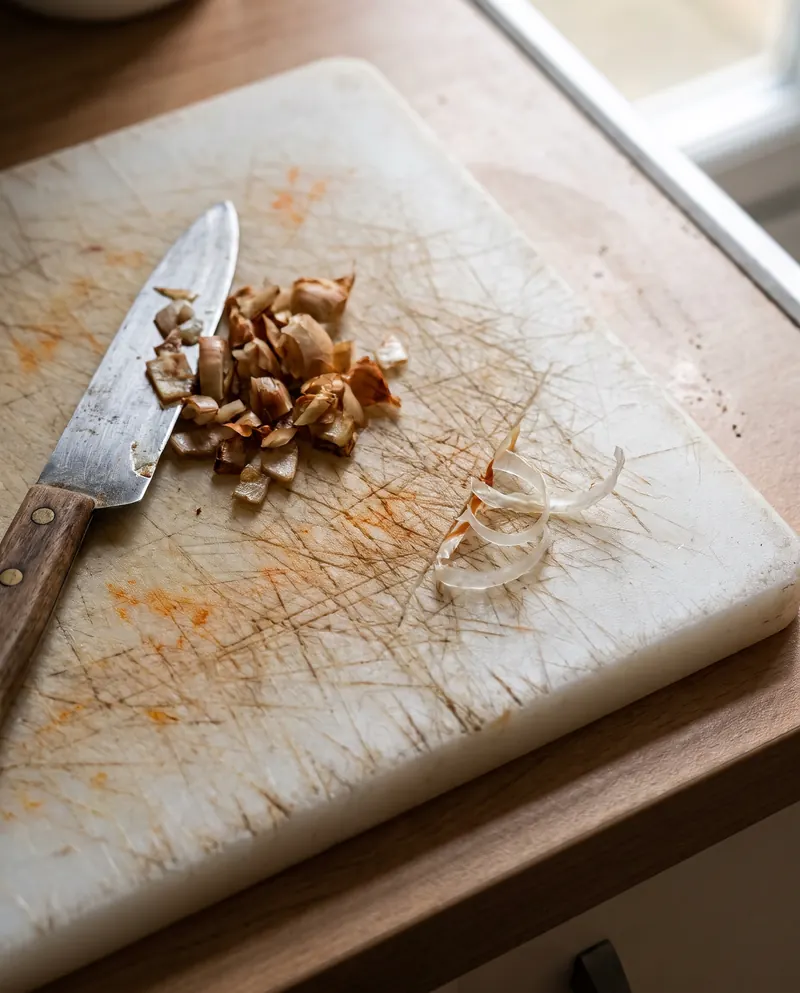
Pick up the chopping board you used tonight and tilt it towards the window. If it is plastic and more than a few months old, you will see it: a fine web of knife cuts, some of them deep enough to catch a fingernail.
Every one of those grooves used to be plastic. So where did it go?
What the researchers measured
In 2023, a team at North Dakota State University set out to answer exactly that. They had volunteers chop carrots on new polyethylene and polypropylene boards, the two plastics most chopping boards are made of, and then counted the particles that came off.
Their findings, published in the journal Environmental Science & Technology:
- Ordinary chopping released tiny plastic particles from both kinds of board.
- Scaled up to a year of home cooking, they estimated that food preparation could produce somewhere between 14 and 71 million polyethylene particles on a polyethylene board, and around 79 million on a polypropylene one.
- The numbers depend on how you cook: your chopping style, how much force the food needs, how finely you chop and how often you use the board.
What it does not mean
We want to be straight with you here, because a lot of advertising about this is not.
The same researchers ran an early lab test on mouse cells and found no substantial effect on cell survival from the polyethylene and wood particles they tested. The lead researcher called that part very preliminary. Nobody can tell you yet what years of tiny plastic particles in food mean for people, and we will not pretend to.
What we can say is simpler: if you would rather have less plastic in your salad, the board is one of the easiest places to start. You use it every day, and it touches almost everything you eat raw.
Is wood the answer?
Wood has no plastic in it, which is a good start. To be fair, in the same study wooden boards shed 4 to 22 times more tiny particles than the plastic ones, depending on the test. Those particles are wood, not plastic, and the study did not put a yearly number on them.
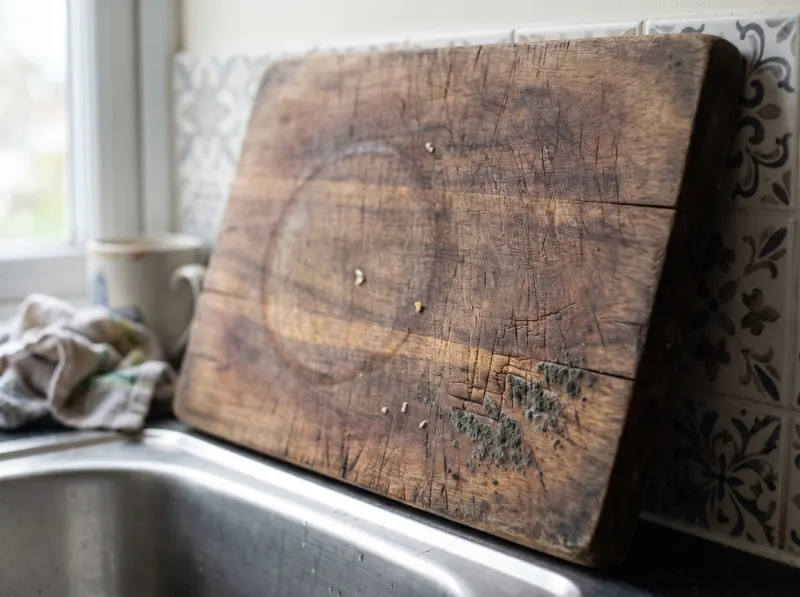
The bigger problem with wood is water. Timber soaks up juice and smells, the garlic from Tuesday is still there on Thursday, and a board that never fully dries can grow mould in its cuts. Bamboo boards are pressed together with glue. All of them need oiling, drying and a bit of luck.
Why we went with titanium
Barechop is a chopping board made from one slim sheet of pure titanium. That gives it three useful habits:
- There is no plastic in it to shed. It is solid metal, not a coating over plastic and not a plastic blend.
- Nothing soaks in. The surface is non-porous, so beetroot, garlic and onion rinse off under the tap in seconds, and there is no knife-groove gunk.
- Water does not hurt it. It cannot swell, crack or go mouldy the way timber can, and there is nothing to oil.
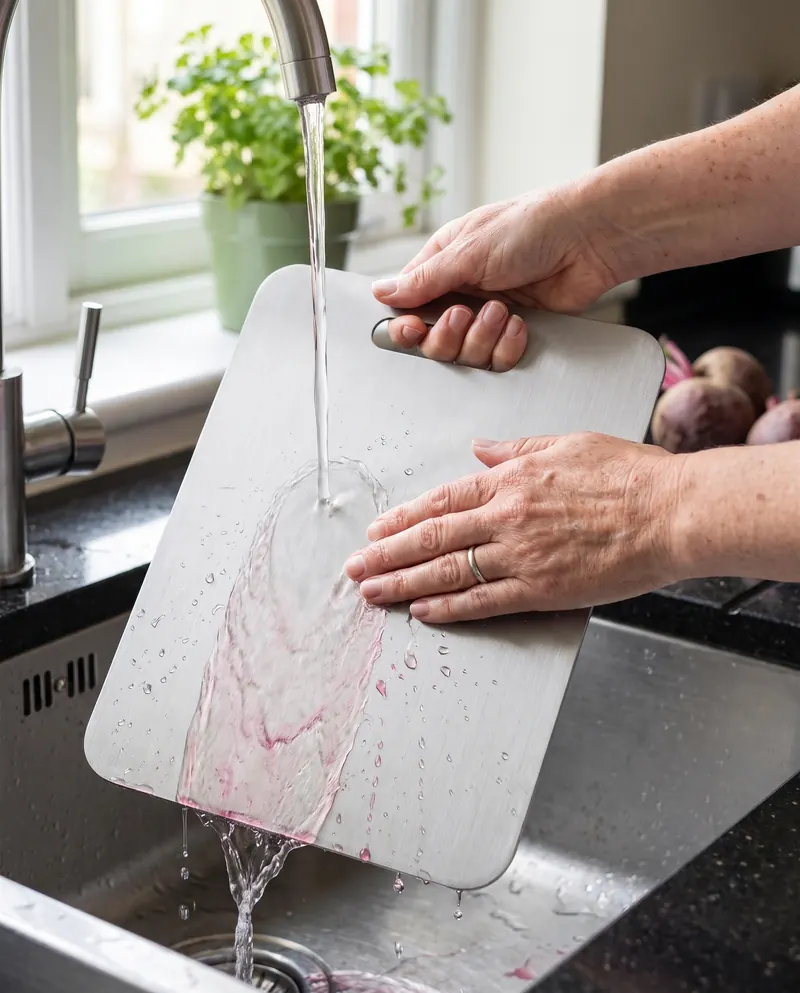
How can you tell titanium from steel? Weight. Our 34 x 23 cm board is a 1.0 mm sheet, listed at 370 g packed. The same sheet in stainless steel would weigh about 620 g. When America's Test Kitchen tested metal boards sold as titanium, two of the three turned out to be stainless steel, which is why we give you the number to check.
The honest small print
- It is harder on knives than wood. Any metal board is. Use it for prep and serving, slice rather than hack, and hone your knife every week or two. Keep a wooden board for heavy cleaver work.
- It is slim. A 1.0 mm sheet is light and easy to store, not a heavy butcher's block. Put a damp tea towel under it if it slides on a smooth bench.
- Wash it by hand. Our supplier does not state that it is dishwasher safe, so we do not claim it. It takes about ten seconds.
- No reviews yet. Barechop is new and we will not make any up.
Try it for 60 days
Chop on it for 60 days. If you do not love it, email us your order number and a photo of the board and we refund you. You do not have to post it back overseas.
The Board (34 x 23 cm) is A$79. The Duo adds a small 25 x 15 cm board for fruit, cheese and garlic, for A$109. The Set has all three sizes for A$149 and makes an easy Christmas gift: order by 5 December for the best chance of delivery before Christmas (our estimate, not a promise).
Shipping across Australia is free and tracked. It ships within 1‑3 business days from our partner warehouse and arrives within 8‑14 business days of your order.
See the titanium board Free tracked shipping. 60-day guarantee.
Or see The Duo for A$109 Free tracked shipping. 60-day guarantee.
This page is an advertisement for Barechop, a brand of Codext GmbH. Lifestyle pictures are illustrations; product photos show the real board. Questions: contact us.